

Last Updated: November 19, 2026
Quick Summary
Advanced PMU certification is a focused training program that builds on your foundation skills in permanent makeup, closing specific skill gaps rather than teaching basics. Choose one by auditing your readiness, matching requirements to your goals, and verifying accreditation before you pay.
- Photograph healed results, not fresh work, and organize your portfolio by procedure.
- Certification proves you completed training; licensing is government permission to practice.
- Ask how many practice models each student works on and who supervises practical sessions.
- Budget five cost lines: tuition, supply kit, practice models, travel, and time off work.
- Divide total cost by expected new procedures to get a comparable cost-per-procedure figure.
Table of Contents
- Is Advanced PMU Certification for Experienced Artists Worth It?
- Step 1: Audit Your Readiness Before You Enroll
- Step 2: Match PMU Certification Requirements to Your Goals
- Step 3: Read the PMU Course Curriculum Line by Line
- Step 4: Confirm Which Advanced PMU Techniques Are Taught Hands-On
- Step 5: Verify Accreditation and Understand PMU Certification vs Licensing
- Step 6: Ask About Mentorship, Feedback, and Healed Results
- Step 7: Budget for Tuition and Plan Your Return
- Frequently Asked Questions
Is Advanced PMU Certification for Experienced Artists Worth It?
Advanced PMU certification for experienced artists is a focused training program that builds on foundation skills in permanent makeup. For artists already working with clients, it’s less about learning the basics and more about closing specific skill gaps.
Working artists often ask this question. They have clients, a machine, and results they’re not fully proud of.
The core argument: most experienced artists don’t need more training. They need the right training, evaluated against evidence rather than marketing copy.
Step 1: Audit Your Readiness Before You Enroll
Readiness for advanced training comes down to three things: consistent client volume, a portfolio of healed work, and honest self-assessment of where your results fall short. Without those, advanced certification becomes expensive theory.
Signs You Have Outgrown Foundation Training
A common mistake is enrolling in advanced training to escape a slow client base. That rarely works. The stronger signal is turning work away because you don’t trust your technique on a particular procedure.
Here’s what genuine readiness looks like:
- You’ve completed a foundation course and worked on real clients, not just practice skins
- You can name the specific techniques you struggle with, such as ombre brows or lip color correction
- Your healed results are consistent enough that you can predict outcomes
If you can’t fill in those blanks, spend more time on foundation work first.
Building a Healed-Work Portfolio That Proves Readiness
Photograph healed results, not fresh work. Healed work shows what your pigment retention and color theory actually produce once the skin settles.
Organize by procedure: brows, eyeliner, and lip blush. Include the technique used and weeks post-procedure for each photo. That documentation signals a professional who thinks about outcomes and gives you a baseline to measure your certification against later.
Step 2: Match PMU Certification Requirements to Your Goals
PMU certification requirements vary by program, but the ones that matter are prerequisites, procedure coverage, and whether the credential is recognized by employers and clinics.
Ask what the certification needs to do. Adding lip blush to your menu? A brow-heavy program won’t serve you. Targeting a medical aesthetics clinic?
If you’re pursuing several advanced brow credentials at once, it can help to compare bundled brows specialist certifications so you’re not paying for overlapping content across separate courses.
Step 3: Read the PMU Course Curriculum Line by Line
The PMU course curriculum is where marketing claims meet reality. Read it line by line and look for specific technique names, hours of hands-on time, and assessment methods rather than vague promises.
Watch out: a curriculum listing “advanced brows” as a single line item is telling you something. Look for breakdowns into microblading, powder brows, and ombre brows, each with its own practice component.
Technique Coverage: Brows, Lip Blush, and Eyeliner
Coverage should be explicit across brows, lip blush and lip pigmentation, and eyeliner. If a program claims all three but devotes most hours to one, you’re paying for content you won’t use.
For artists focused on advanced brow work, review the nano brows certification program curriculum to see how hands-on coverage is structured. If lip work is your goal, the lip color tattoo certification details show what the technique training includes. And for artists adding eyeliner, the eyeliner tattoo certification page lays out what that credential covers.
Step 4: Confirm Which Advanced PMU Techniques Are Taught Hands-On
Hands-on training is the dividing line between advanced PMU techniques you can actually perform and techniques you’ve only watched. Confirm the practice format before you enroll.
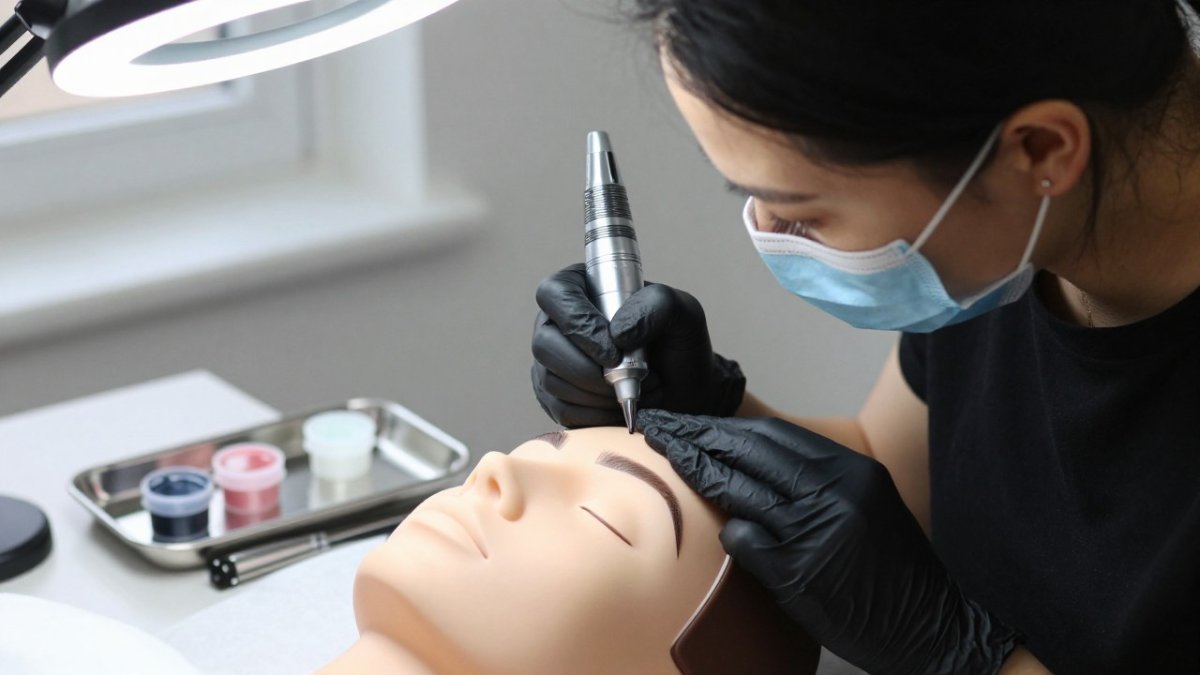
Ask three direct questions: How many practice models does each student work on? Is training one-to-one or in a large group? Who supervises practical sessions?
Step 5: Verify Accreditation and Understand PMU Certification vs Licensing
PMU certification vs licensing is a distinction many artists blur, and that blur is expensive. Certification proves you completed a training program. Licensing is government permission to practice, governed in Canada by provincial and municipal public health rules, not by schools.
That means accreditation is your quality signal for the training itself, and it deserves more scrutiny than a logo row on a sales page.
What Each Accreditation Body Actually Verifies
Accreditation is not a single stamp. Different bodies review different things, and knowing which is which tells you what a school has actually proven.
- Career college associations review institutional operations: business practices, instructor qualifications, student contracts, and complaints processes. Recognition here tells you the school is a regulated private career college, not a weekend workshop.
- Industry-specific PMU bodies review curriculum content and technique standards: procedure coverage, hours of hands-on practice, sanitation protocols, and assessment methods. Recognition here tells you the training itself has been benchmarked against a professional standard.
- Provincial or territorial private training regulators authorize the school to operate and, in some provinces, to enroll students under consumer protection rules. This is a legal operating status, not a quality ranking.
A school can hold one, two, or all three. Ask which body reviewed which part of the program, and ask for the certificate or registration number so you can confirm it independently.
How to Verify a Credential Before You Pay
Verification takes about ten minutes and saves months of regret. Work through these checks in order:
- Confirm the school’s operating status. Search the provincial private training regulator’s public registry for the school’s legal name. If it does not appear, ask why before enrolling.
- Confirm the accreditation claim. Contact the accrediting body directly and ask whether the specific program, not just the school, is recognized, and for what period.
- Read the certificate language. Ask for a sample certificate. It should name the procedures covered, the hours completed, and the assessment method. A certificate that says only “advanced PMU” tells an employer nothing.
- Ask what the credential does not authorize. A reputable school will tell you plainly that its certificate does not grant a license, does not permit you to practice where licensing is required, and does not cover procedures outside the curriculum.
Watch out: a school that cannot produce a registration number, a sample certificate, or a named accrediting contact is asking you to trust marketing copy over evidence.
What Your Certificate Does and Does Not Authorize
A PMU certificate is evidence of training. It is not a scope-of-practice document. In practice, that means:
- It supports your application for a business license or public health permit where your municipality requires one.
- It may satisfy an insurer’s requirement for professional liability coverage, but you must confirm the specific procedures your policy covers.
- It does not authorize you to perform medical tattooing, paramedical pigmentation, or any procedure reserved for regulated health professionals in your province.
At the Joe Cepeda Institute, we hold accreditation from CAMACS, CAPMUP, AACC, and NACC, and we were the first permanent makeup school in Canada to receive CAPMUP accreditation.
Before enrolling anywhere, confirm what licensing your region requires separately from the course, then confirm what the certificate will and will not do where you actually work.
Step 6: Ask About Mentorship, Feedback, and Healed Results
Post-training mentorship is the difference between a course and a career. Ask what support continues after the final day and how feedback on healed results is handled.
Ask for examples of how graduates were supported after certification.
Step 7: Budget for Tuition and Plan Your Return
Tuition is a significant investment, and the honest way to evaluate it is to compare total cost against the revenue the new credential is likely to generate.
We don’t publish fixed figures here because costs vary by course and intake. Instead, here is the framework we recommend for building a real number, and the questions to ask so the quote you receive is comparable to the next one.
Build the True Total Cost
Budget around five lines, not one. Ask each school to confirm every line in writing before you compare.
| Cost Category | What to Confirm | Why It Matters |
|---|---|---|
| Tuition | What the fee covers, and what triggers additional charges | Avoid surprise add-ons mid-course |
| Supply kit | Included, partially included, or separate; which machine and pigments | A separate kit can add a large line to the total |
| Practice models | Provided, sourced by the student, or paid per model | Model fees are the most commonly underestimated cost |
| Travel and accommodation | Required for in-person intensives; number of trips | A multi-visit format multiplies this line |
| Time off work | Days away from clients, plus recovery and practice time after | Lost income is a real cost, not an abstract one |
Add the lines, then divide by the number of new procedures you expect to offer. That gives you a cost-per-procedure figure you can compare across programs.
Model the Return Before You Commit
Return on advanced training comes from three levers: a higher price per service, more services per client, and a shorter learning curve on corrective work you currently decline or discount.
Work through the math with your own numbers rather than ours:
- Price uplift. Estimate the increase you can justify on procedures the certification improves. If your current brow price is X and your healed results after training support a higher price, the difference multiplied by your monthly brow volume is your monthly uplift.
- Menu expansion. Count the clients who already ask for a procedure you don’t offer. That is your ready-made demand for the new technique, and it usually recovers a meaningful share of tuition faster than cold acquisition.
- Corrective work. Estimate how many corrective cases you turn away per month and price them at your intended rate.
- Break-even month. Divide total cost by your combined monthly uplift. The result is the month you break even. If that number is longer than you are comfortable with, negotiate scope, take one technique now and add the second later.
Watch out: a program that quotes tuition but cannot itemize supplies, model fees, and assessment costs is not giving you a comparable number, and the gap usually appears after you have paid.
Questions to Ask Before You Sign
- Is the supply kit included, and does it contain the machine and pigment line used in the curriculum?
- Are practice models provided, and how many per student?
- Are there separate fees for assessment, certification issuance, or follow-up review?
When you’re ready to discuss tuition and scheduling, you can contact the school directly to get current details for your situation, including an itemized breakdown you can compare line by line.
Frequently Asked Questions
What should an experienced PMU artist look for in an advanced certification program?
Look for four things: a curriculum that goes beyond foundation techniques into corrective work, color theory, and skin assessment; documented hands-on hours on practice models; accreditation you can verify with the issuing body; and post-course mentorship. Ask how competency is assessed, not just how many days the course runs.
Does an advanced PMU certificate replace local licensing or health requirements?
No. PMU certification vs licensing are different things: a certificate proves you completed training, while licensing or public health permits come from your local municipality or provincial health authority. Requirements vary by province and municipality, so confirm what your local health unit requires before you take clients. Advanced training supports your application but does not substitute for it.
How much hands-on practice should an advanced PMU course include?
Enough that you leave having worked on live models under supervision, not just synthetic skins. Ask for the exact number of practice models and how many hours are supervised one-to-one. If a course is mostly lecture or online video with a short in-person component, your technique mastery will depend on what you practice afterward. Confirm the ratio of supervised practice to demonstration before you enroll.
How can I verify a PMU training program’s accreditation or recognition?
Contact the accrediting body directly rather than relying on the school’s own claims. In the Canadian PMU and aesthetics space, check recognition from bodies such as CAPMUP, CAMACS, AACC, and NACC. Ask the school which specific programs are accredited, since institutional membership and course accreditation are not the same. A school that can name its accreditors and let you verify them is giving you a credential employers can check.
